Em
by Travis Jeppesen on November 10, 2021
“With the deft hand of the master craftsman, Thúy weaves the narrative in and out of linearity, allowing each piece of narrative to announce its rightful place in the puzzle.”
A review of Kim Thúy’s Em at Asian Review of Books.
‘Liquid Ground’ Closing Event: Artists’ Talk with Curators
by Travis Jeppesen on November 6, 2021
7 Nov Sun, 1–2:30PM HKT
Zoom ID: 828 4558 8472
Passcode: 726412
Direct link
Artists: Travis Jeppesen, Yi Xin Tong, and Alice Wang
Moderated by: Junyuan Feng and Alvin Li
English
To mark the closing of ‘Liquid Ground’, the curators invite three participating artists—Travis Jeppesen, Yi Xin Tong, Alice Wang—to share their practice, focusing on the works they contributed to the exhibition. The event will also include a brief virtual tour led by the curators for those living outside of Hong Kong unable to travel and view the exhibition due to COVID-19 travel restrictions. See you online this Sunday!
Lemon
by Travis Jeppesen on November 5, 2021
“What comes to matter more are not the details of the unsolved case itself, but the psychological after-effects that have afflicted all the surviving characters in the intervening years; their reflections, their experiences of lost innocence, form a delicately woven tapestry of voices grappling with doubt and the meaning of lives lived beneath the cloud of uncertainty.”
A review of Kwon Yeo-sun’s novel Lemon, at the Asian Review of Books.
Strange Beasts of China
by Travis Jeppesen on September 22, 2021
“Fabulism is in many ways an embrace of this idea of writing as not-knowing, a form in which no concessions to reality need be made.”
A review of Yan Ge’s new novel, Strange Beasts of China, at the Asian Review of Books.
Shuang Li
by Travis Jeppesen on September 11, 2021
“Try as we might to patch up the sky, to project what we regard as the substance of ourselves across time and virtual space, we are in fact bounded by physical bodies. Indeed, what is most jolting and unnerving about Li’s art (visceral sounds and images aside) is its staging of vulnerability.”

On Shuang Li, in the September issue of Artforum.
The Sagosian Markmakers
by Travis Jeppesen on September 9, 2021
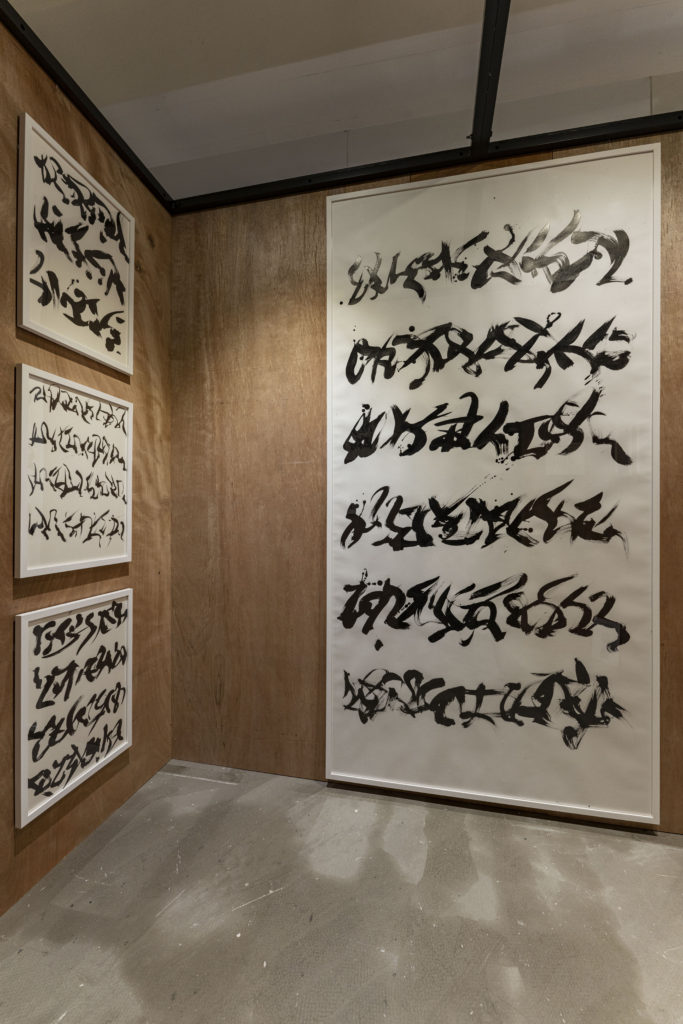
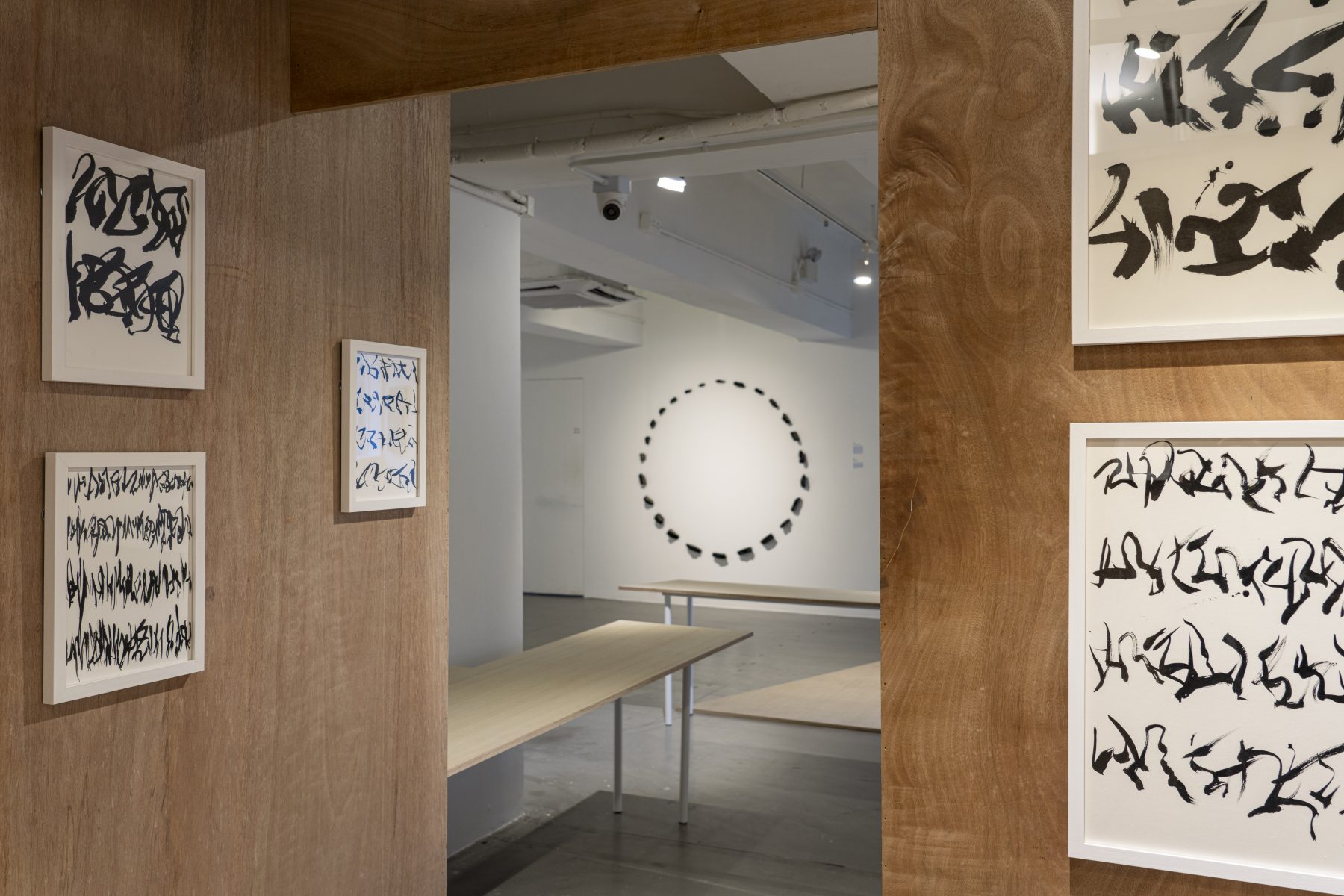
In The Sagosian Markmakers: An Anthropological Interlude (2021), writer and artist Travis Jeppesen transforms the exhibition space into a display room of a faux-archeological museum housing a series of calligraphic works of purportedly Sagosian origin. Sagosia, a fictional island on the Indian Ocean, features in Jeppesen’s forthcoming novel Settlers Landing as a pirate colony, originally founded by a mixed group of Creole and southern Chinese pirates, which later fell under British rule. The quintessential art form of Sagosia is a kind of mark-making performed in quasi-ceremonial style after imbibing rum and entering a trance state. As one enters the display room the audio guide boasts about the history of Sagosia and the provenance of this set of works on view, in a language rich with colonial undertones. Through this satirical narrative the artist ridicules with both humor and acuity the colonial fetishization of indigenous cultures preserved out of context in encyclopedic museums, a peculiar phenomenon of Western modernity. This fictional narrative and its indecipherable works on paper exude a radical illegibility and a wildness that could be considered the artist’s paean to the anarchic nature of many actually-existing island cosmologies world-wide throughout history.
Currently on view, until November 14, 2021, in Liquid Ground
Curated by Alvin Li and Junyuan Feng
Para Site
22/F, Wing Wah Ind. Building
677 King’s Road, Quarry Bay
Hong Kong
www.para-site.art
Facebook / Instagram / Vimeo / YouTube
A Correction
by Travis Jeppesen on August 24, 2021
In See You Again in Pyongyang, I incorrectly wrote that Alek Sigley’s scholarship from the Australian government that prevented him from entering North Korea ended in 2019. In fact, as Alek has recently brought to my attention, the scholarship ended in late 2017/early 2018. I apologize for this error and the confusion it might have caused.
-Travis Jeppesen
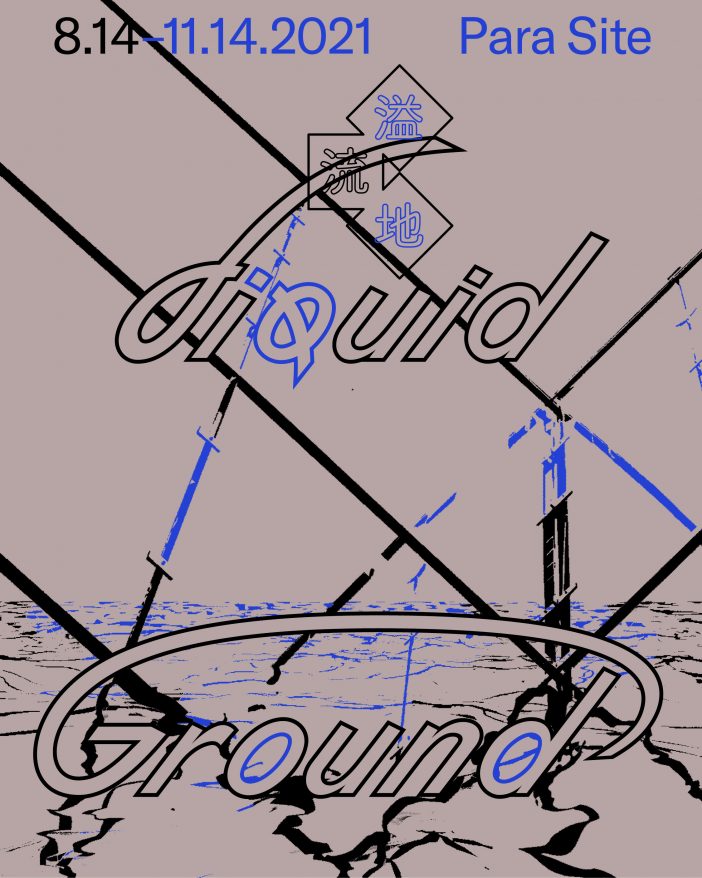
Liquid Ground
by Travis Jeppesen on July 22, 2021
Coming soon to Hong Kong….
August 14–November 14, 2021
Opening reception: August 13, 7–9pm
Para Site
22/F, Wing Wah Ind. Building
677 King’s Road, Quarry Bay
Hong Kong
info@para-site.art
www.para-site.art
Facebook / Instagram / Vimeo / YouTube
Leelee Chan, Cui Jie, Future Host, Ho Rui An, Travis Jeppesen, Jessika Khazrik, Heidi Lau, Lee Kai Chung, Riar Rizaldi, The Centre for Land Affairs, Yi Xin Tong, Alice Wang, Gary Zhexi Zhang, Zheng Bo, Zheng Mahler
Curated by Alvin Li and Junyuan Feng
Liquid Ground is a proposal for a future commons, still up in the air, that will one day be underwater.
In Nagisa Oshima’s Cruel Story of Youth (1960), a concrete-armored coastline serves as the interface between postwar Japanese urban space and the uncharted, timeless ocean, and a faultline along which the protagonists contemplate and whisper. Parallel to its “lovers against the world” plot is the agon between human-made tectonics and the erosive, elemental forces of nature. Now, decades later, humanity finds itself in an age of ever more intensive terraforming: From Penang and Shanghai to Macau and Singapore, coastal cities across Asia compete to turn natural bodies of water into the solid ground over which capital flows and pulsates. Hong Kong, too, has a long history of land reclamation, with large-scale projects dating back to the mid-19th century. In expanding their shorelines by dumping sand and rocks into the open sea, cities trade water for a flattened, abstract tabula rasa that often becomes a theatre for technocratic hubris ad absurdum. One example of this dark Prometheanism is “Lantau Tomorrow Vision,” a controversial infrastructure project proposed in 2018 by Hong Kong chief executive Carrie Lam. Touted as “a solid foundation for a sustainable future for Hong Kong,” the project aims to reclaim 1,700 hectares from the sea at 624 billion HKD, to turn Lantau Island into Hong Kong’s third economic hub by 2030—that is, a few decades before the supposed drowning of many Asian metropolises under the effects of the climate catastrophe.
Amid the fugue of earth and water, the dialectic of solidification and dissolution,Liquid Groundseeks to confront an as-yet-unsettled plan with a series of new commissions and recent works. The allegory of an island courses throughout the exhibition as a leitmotif—islands, as ecological units and places of dwelling, are isolated but open, liminal but self-sufficient, constantly phase-shifting between solid, liquid, and spirit. As some works tap into sites of ruthless extraction and administered flows of energy to unpick the calamity of state-of-the-art developmentalism, others turn to primordial sea myths and ecological kin-making to seek antidotes for the malaise of modernity. Some hijack the materials of urban infrastructure to invent new assemblages, reimagining the shape of our commons, while others venture beyond the city to give voice to the nonhuman, the flora and fauna local to Lantau Island. Engaging an eclectic range of perspectives, from the living to the inert, these artists delve into the complex material histories of their respective locales to propose scripts of their own, defying the hegemony of technocracy while opening up new ways of seeing and sensing our ecological enmeshment. The exhibition will be further accompanied by a rich range of public programmes led by artists, thinkers, and practitioners from various fields, taking visitors outside the exhibition space in Quarry Bay to explore different corners of the city.
The curatorial proposal of Liquid Ground was chosen from Para Site’s international open call for exhibition proposals from emerging curators, now in its sixth year. Liquid Ground is a collaboration between Para Site and UCCA Center for Contemporary Art. Select works in the exhibition have been developed and co-commissioned with the UCCA Center for Contemporary Art, which will be hosting a travelling iteration of the exhibition at UCCA Dune, Beidaihe, in Spring 2022.
Liquid Ground is financially supported by the Project Grant of the Hong Kong Arts Development Council. The Hong Kong Arts Development Council fully supports freedom of artistic expression. The views and opinions expressed in this project do not represent the stand of the Council.
U in a movie called The Green Ray
by Travis Jeppesen on July 6, 2021
A short story, U in a movie called The Green Ray, in the latest issue of Mousse.
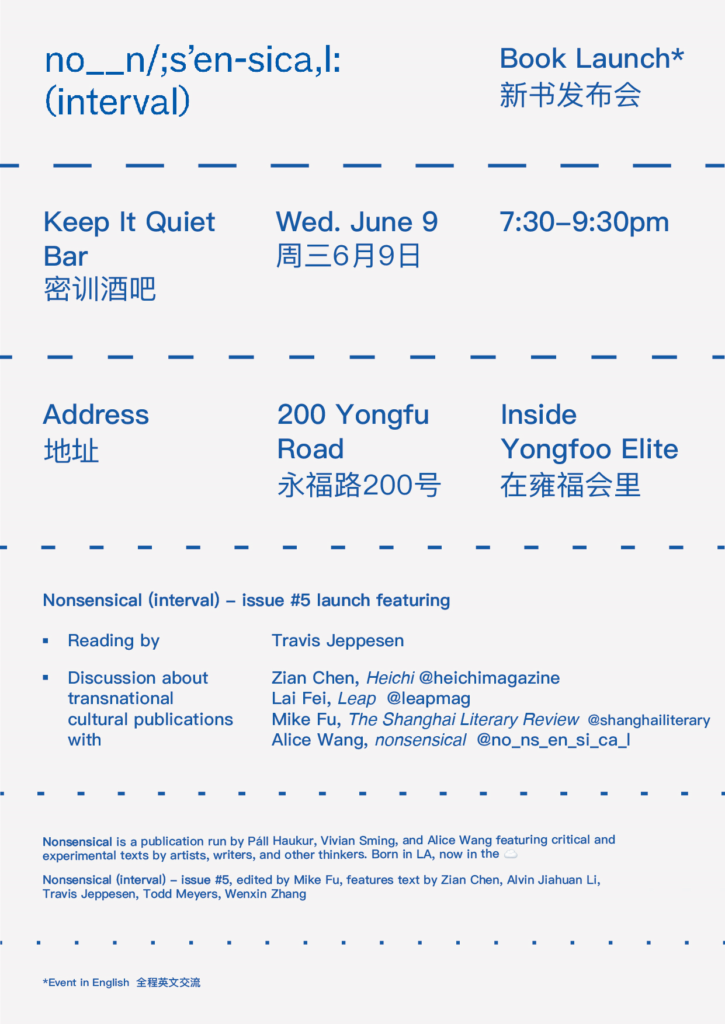
Nonsensical Launch: June 9 in Shanghai
by Travis Jeppesen on June 3, 2021